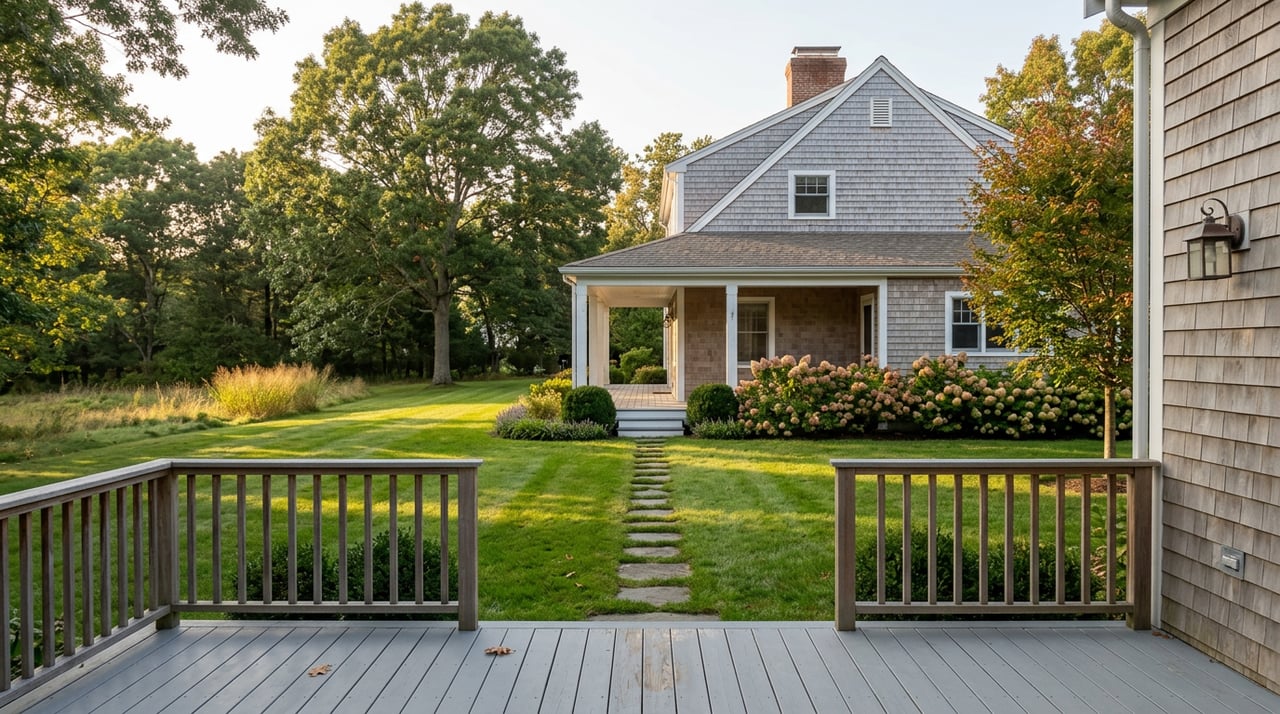
What does it actually mean when a listing says "Winchester, VA"?
Two buyers can pull up two homes, both addressed the same way, both sitting inside the same ZIP code, and end up owing property tax bills that differ by nearly two thousand dollars a year. Neither home is mispriced. Neither listing is wrong. The city name on the address has nothing to do with which government actually taxes the property, and almost nothing on a real estate portal tells you which one applies until you're already comparing two homes as if they're the same product.
They aren't. Here's why.
An Address Isn't a Jurisdiction
Winchester is one of Virginia's independent cities, a legal category that doesn't exist in most other states. Being an independent city means Winchester is not part of Frederick County in any governmental sense, even though the county surrounds it on every side and even shares its name for tax and services purposes with dozens of neighborhoods that carry a Winchester mailing address. The city has its own council, its own budget, and its own tax rate. Frederick County has all of that too, entirely separately. A resident pays one or the other, never both, depending on which side of an invisible line their parcel falls on.
That line has not moved in over fifty years.
How the Boundary Got Frozen in 1970
Winchester's current footprint traces back to a court-ordered annexation finalized at the end of 1970, when the city absorbed roughly six square miles and about 5,000 residents from Frederick County, including the land that became the Whittier Acres subdivision and the properties along Meadow Branch Avenue. The county fought it. Frederick County's Board of Supervisors chairman, Thomas Rosenberger, testified during the annexation trial that he believed the city was after what he called
"the cream of the county."
The judges expanded Winchester's boundary anyway, and ordered the city to pay the county roughly a million dollars, plus five years of additional payments, to compensate for the lost tax base. That was the last major redraw. A 1987 state law then froze annexation statewide for cities like Winchester, and the boundary that resulted from the 1970 ruling is essentially the boundary that exists today. The city can't grow outward the way a typical municipality might. Everything beyond that line, no matter how close it sits to Old Town or how much it looks and feels like the city, is Frederick County.
The ZIP Code Doesn't Know Either
Here's where it gets confusing for anyone house hunting by search filter. USPS ZIP codes were drawn for mail delivery, not for tax jurisdiction, and Winchester's ZIP codes cross the city-county line freely. Addresses in 22601 include homes zoned for Winchester City Public Schools, like Garland R. Quarles Elementary and John Handley High School, sitting alongside homes in the very same ZIP code zoned for Frederick County Public Schools, like James Wood Middle School. Move out to 22602 or 22603 and the mailing address still reads "Winchester, VA," but the schools are entirely Frederick County Public Schools campuses, places like Admiral Richard E. Byrd Middle School and James Wood High School. None of that shows up in the city name. It only shows up once you check the parcel.
Even the county's own tax office runs into this. Frederick County's Commissioner of the Revenue, the office responsible for assessing property outside city limits, lists its physical address as 107 N Kent St., Winchester, VA 22601. The government that taxes you separately from the city still gets its own mail addressed to Winchester.
What the Two Jurisdictions Actually Charge
The tax rate gap between the two is not a rounding error. Frederick County's real estate tax rate for 2026 is 53 cents per $100 of assessed value, set by the county and published on its own site. The City of Winchester's most recently confirmed rate, for tax year 2025, was $0.795 per $100, and properties inside the city's designated downtown districts carry additional levies on top of that: an extra $0.230 per $100 in the Primary Downtown district and $0.130 per $100 in the Secondary Downtown district.
Here's what that looks like on a home assessed at $400,000:
| Jurisdiction | Rate per $100 | Annual tax |
|---|---|---|
| Frederick County (2026) | $0.53 | $2,120 |
| City of Winchester, base rate (TY2025) | $0.795 | $3,180 |
| City of Winchester, Secondary Downtown | $0.925 | $3,700 |
| City of Winchester, Primary Downtown | $1.025 | $4,100 |
A buyer comparing a $400,000 home just outside the city line to a $400,000 home in Winchester's Primary Downtown district is looking at a $1,980 annual difference in property tax alone, before factoring in anything else about the two properties. That gap holds every year the homeowner owns the house. Over a ten-year hold, it's nearly $20,000, money that never shows up in the sale price comparison two buyers might do side by side on a portal.
None of this makes one jurisdiction better than the other. Frederick County's lower rate reflects a different scope of services and a different budget structure than an incorporated city runs. Winchester's downtown levies fund the infrastructure and programming specific to that commercial core. The point isn't which is the better deal. The point is that the two numbers aren't interchangeable just because both addresses say Winchester.
How to Find Out Which Side of the Line You're On
Before assuming a listing's price reflects one tax environment or the other, there are a few concrete ways to check:
- Ask whether the parcel is billed by the City of Winchester Treasurer or the Frederick County Treasurer. That single answer tells you the tax rate and confirms the school division.
- Pull the parcel from the applicable GIS or property record system rather than relying on the mailing address. City limits and county lines are drawn on a map, not in a ZIP code database.
- If the home sits near Old Town, ask specifically whether it falls inside a Primary or Secondary Downtown levy district, since that adds a real, ongoing cost on top of the base city rate.
- Confirm the assigned school division directly rather than assuming from the address, especially in 22601, where city and county zoning sit inside the same ZIP.
Any of these can be confirmed before a buyer writes an offer, and they should be, because the tax line item on a closing disclosure is not negotiable the way a repair credit might be.
FAQ
If a home is annexed into the city someday, does the tax rate change automatically? Winchester hasn't annexed new land since the 1970 case, and the 1987 state moratorium made further annexation by cities like Winchester exceedingly rare going forward. A property's jurisdiction today is a reliable indicator of its jurisdiction for the foreseeable future.
Does living in Frederick County near Winchester mean giving up access to the city? No. Proximity to Old Town, downtown restaurants, and city amenities doesn't depend on which government taxes the property. Plenty of Frederick County addresses sit minutes from the same downtown a city resident would walk to.
Is the lower county rate always the better financial choice? Not necessarily. Rates fund different service packages, and a buyer's decision should weigh the full picture, including school assignment, proximity, lot size, and home condition, not the tax line alone.
Can I ask a seller or listing agent to confirm the jurisdiction before I tour a home? Yes, and it's a reasonable question to ask early. It saves everyone time if a buyer has a strong preference for one school division or tax structure going in.
Working Through the Line With Someone Who Knows Where It Is
A tax rate difference this size deserves more than a glance at a listing's city name. Whether you're comparing an Old Town property against something just across the line in Frederick County, or you're trying to understand what a specific parcel's assessed value means for your monthly carrying cost, the details are knowable before you write an offer, not after you get a bill.
Talbot Greenya Group works this boundary daily across Winchester and the surrounding Shenandoah Valley. Get your instant home valuation or schedule a consultation, and we'll walk through exactly which jurisdiction a property sits in, what it costs, and what it means for your long-term plans, before you have to guess.